
8 Types of SaaS Explainer Videos and Which Funnel Stage Each One Is Built For
Most SaaS companies don’t have a video problem.
They have a video alignment problem.
They create one explainer video and expect it to work everywhere: homepage, ads, sales, onboarding. It becomes a catch-all asset that ends up being too generic to perform well in any one place.
And that’s where things break.
Because buyers don’t think the same way at every stage. What works at awareness won’t work at decision. What works at onboarding won’t work at acquisition.
So the real question isn’t “do you need an explainer video?”
It’s which type of explainer video do you need and where does it fit in your funnel?
Let’s break this down properly.
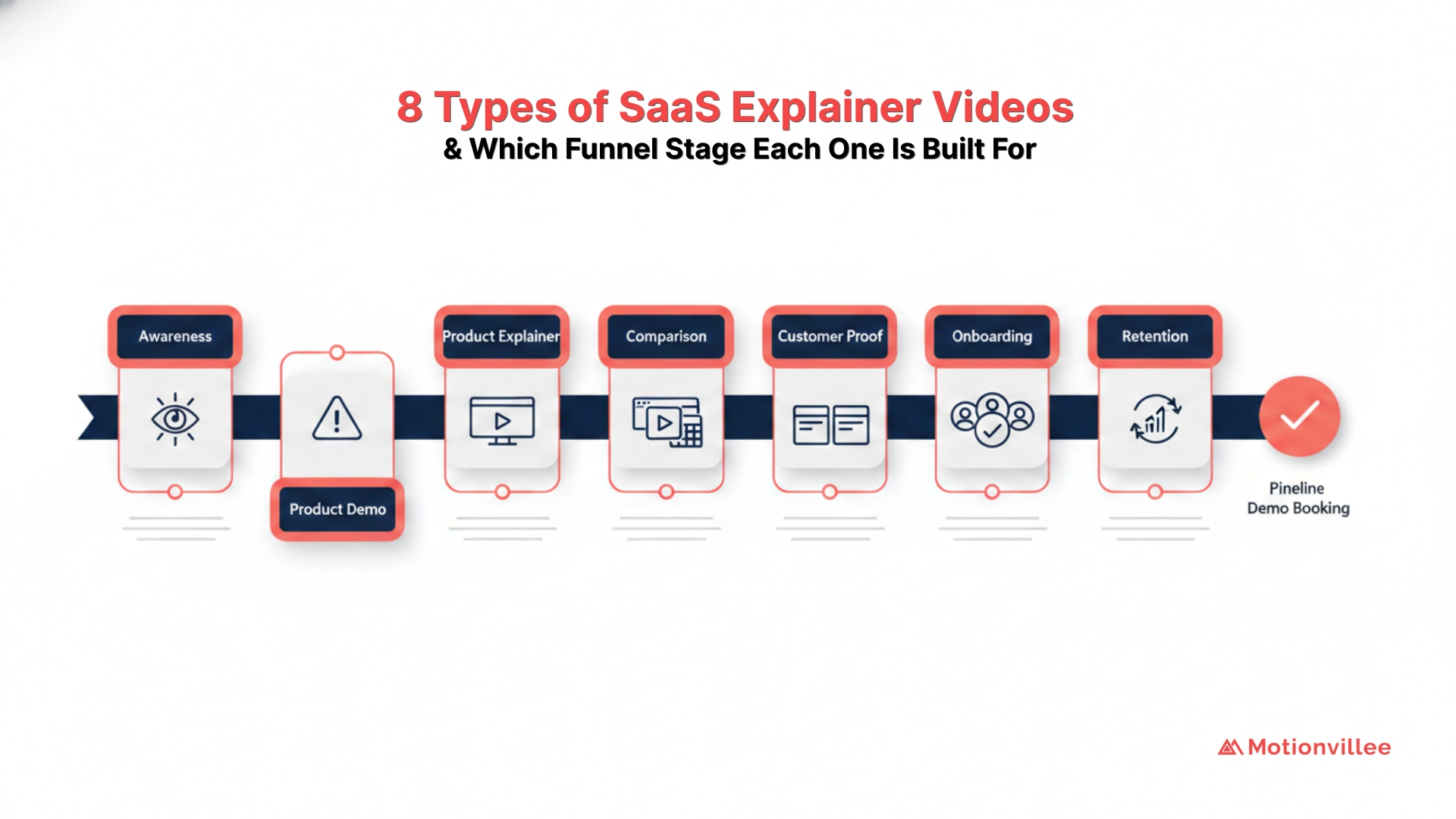
First, Understand the Funnel
Before jumping into types, here’s the simplified SaaS funnel:
- Top of Funnel (TOFU) → Awareness
- Middle of Funnel (MOFU) → Consideration
- Bottom of Funnel (BOFU) → Decision
- Post-Funnel → Onboarding & retention
Each stage represents a completely different mindset.
At TOFU, the user barely understands the problem.
At MOFU, they’re actively evaluating solutions.
At BOFU, they’re comparing options and reducing risk.
Post-funnel, they’re trying to succeed with your product.
Each stage requires a different type of communication.
And that’s exactly why frameworks like There’s a video for every business type, find yours matter because format should always follow intent.
1. Problem-Solution Explainer
Funnel Stage: TOFU (Awareness)
This is the most widely used format—and also the most misunderstood.
It starts with a relatable problem and introduces your product as the solution.
What it does well:
- Builds immediate relevance
- Captures attention quickly
- Makes the viewer feel understood
What it should avoid:
- Feature overload
- Technical jargon
- Over-explaining
At this stage, the goal is not conversion.
It’s a connection.
You want the viewer to think, “This is exactly my problem.”
This format works best on:
- Homepage hero sections
- Paid ads
- Social media campaigns
It aligns closely with insights from How an Animated Explainer Video Can Boost Your Business, where emotional clarity drives engagement.
2. Product Overview Video
Funnel Stage: MOFU (Consideration)
Now the user is aware of the problem and exploring solutions.
This video answers:
What does your product actually do?
It should cover:
- Core functionality
- Key benefits
- High-level workflows
But it should stay simple.
A common mistake here is trying to impress the viewer with too much detail. That usually backfires.
At this stage, clarity beats complexity.
You’re not closing the deal yet you’re keeping the user interested enough to go deeper.
3. Feature-Focused Explainer
Funnel Stage: MOFU (Consideration)
Once interest is established, users start asking:
“Will this actually work for me?”
This is where feature-specific videos come in.
Instead of explaining everything, you go deep into:
- Specific features
- Targeted use cases
- Functional benefits
For example:
- Automation workflows
- Reporting dashboards
- Integration capabilities
These videos help users connect your product to their specific needs.
They also support strategies from How to boost conversions with animated explainer videos, where focused messaging reduces hesitation and improves decision confidence.
4. Product Demo Video
Funnel Stage: BOFU (Decision)
At this stage, the user is close to converting.
They don’t want ideas anymore.
They want proof.
A demo video shows:
- Real interface
- Actual workflows
- Step-by-step usage
This builds trust through transparency.
Unlike explainers, this is less about storytelling and more about showing exactly how things work.
It answers the most important question:
“Can I see myself using this?”
5. Comparison / Differentiation Video
Funnel Stage: BOFU (Decision)
Now the buyer is comparing options.
They are evaluating:
- Competitors
- Pricing
- Features
- Value
This video should clearly communicate:
Why choose you over others?
It can include:
- Side-by-side comparisons
- Unique advantages
- Use-case differentiation
This type of video is often ignored, but it directly impacts final decisions.
Because at this stage, small differences matter.
6. Customer Testimonial / Case Study Video
Funnel Stage: BOFU (Decision)
At the decision stage, trust becomes the biggest factor.
And trust doesn’t come from brands it comes from other users.
These videos show:
- Real problems
- Real experiences
- Real outcomes
They shift the narrative from “we promise” to “this actually worked.”
That reduces perceived risk, which is often the final barrier to conversion.
7. Onboarding / Tutorial Video
Funnel Stage: Post-Funnel
The deal is closed.
Now comes the real challenge activation.
These videos help users:
- Get started quickly
- Understand key features
- Avoid confusion
Good onboarding reduces friction.
And reduced friction leads to better retention.
This connects with structured thinking from Process of creating animated explainer video, where clarity directly impacts user experience.
8. Thought Leadership / Educational Video
Funnel Stage: TOFU → MOFU
This type is not focused on selling.
It’s focused on positioning.
You create content around:
- Industry insights
- Trends
- Best practices
These videos attract the right audience and build credibility over time.
By the time the viewer enters your funnel, they already trust your expertise.
The Biggest Mistake SaaS Teams Make
They try to use one video for everything.
For example:
- A homepage video that tries to explain, demo, and convert
- A demo video used in awareness campaigns
This leads to overloaded messaging.
And when everything is said, nothing is understood.
Each video should have one job.
That’s what makes it effective.
How to Structure Your Video Strategy
Instead of thinking “we need a video,” shift your thinking:
- What stage are we targeting?
- What does the user need right now?
- What is the simplest way to communicate that?
Then build accordingly.
This ensures:
- Better engagement
- Higher conversion rates
- Stronger user experience
And when paired with distribution strategies like How to promote your animated explainer video?, your content doesn’t just exist it actually reaches and influences the right audience.
Final Thought
Explainer videos don’t fail because they’re poorly made.
They fail because they’re poorly aligned.
The right video at the wrong stage won’t work.
But the right video at the right stage can move users forward naturally without friction.
That’s how high-performing SaaS teams think about video.
Not as one-off assets.
But as a structured system that supports the entire customer journey from awareness to retention.