
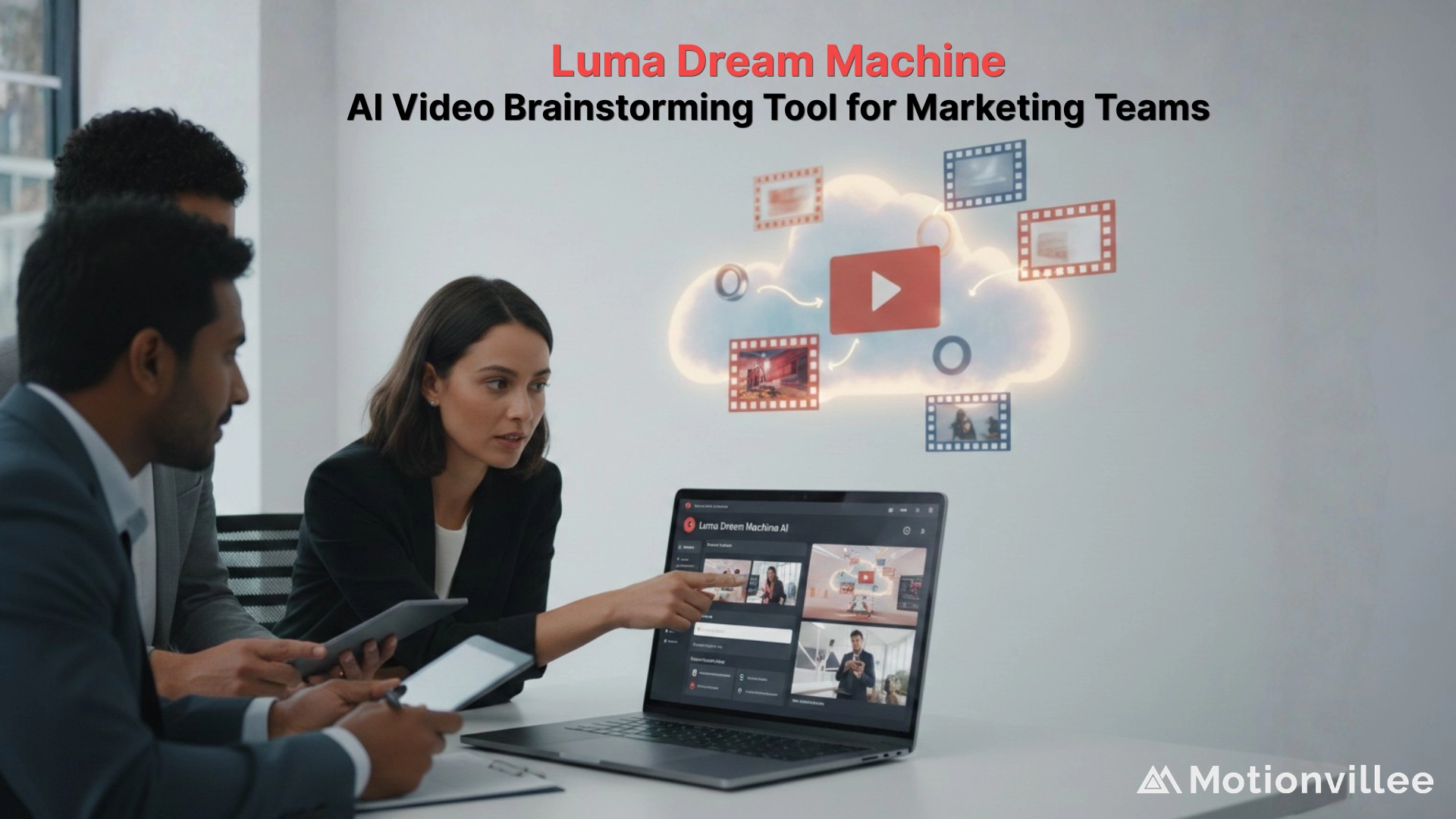
Luma Dream Machine: AI Video Brainstorming Tool for Marketing Teams (Features, Use Cases, Limitations)
B2B video marketing is no longer stuck at the execution stage. The real bottleneck today is ideation.
Teams don’t struggle to produce videos anymore. They struggle to decide what to create, how to visualize it, and whether it will actually work before investing time and budget.
That’s where tools like Luma Dream Machine come into play.
Unlike traditional video tools, this isn’t built just for editing or animation. It’s built for visual thinking. You describe an idea, and the system generates a video representation of it.
That changes how marketing teams approach brainstorming entirely.
Let’s break down what it does, where it fits, and where it still falls short.
What is Luma Dream Machine?
Luma Dream Machine is an AI video generation tool that converts text prompts into short, realistic video clips.
You input something like:
“A futuristic SaaS dashboard with glowing UI elements in a dark office environment”
And the system generates a visual sequence that reflects that idea.
It’s powered by generative AI models trained on large datasets of video and motion patterns, allowing it to simulate:
- Camera movement
- Lighting
- Scene transitions
- Object behavior
Instead of building visuals manually, you’re directing them through prompts.
This makes it less of a production tool and more of a brainstorming accelerator.
Why It Matters for Marketing Teams
Here’s the shift.
Earlier, brainstorming for video meant:
- Writing scripts
- Creating mood boards
- Aligning on abstract ideas
Now, you can actually see the idea before committing to it.
For B2B teams, this creates three advantages:
- Faster alignment across stakeholders
- Better visualization of abstract concepts
- Reduced risk before investing in production
And when combined with fundamentals like How an Animated Explainer Video Can Boost Your Business, you’re not just generating visuals, you’re testing communication.
This is especially useful in environments where multiple decision-makers are involved and visual clarity speeds up approvals.
1. Rapid Concept Visualization
This is the biggest strength.
Instead of explaining an idea in words, you generate it visually.
That helps when:
- Pitching campaign ideas internally
- Presenting to clients
- Exploring creative directions
You move from “imagine this” to “here’s what it looks like” in minutes.
This reduces back-and-forth and speeds up decision-making.
It also reduces the gap between creative and non-creative stakeholders, making collaboration more efficient.
2. Faster Creative Brainstorming
Traditional brainstorming is slow because ideas stay abstract for too long.
Luma Dream Machine changes that by turning ideas into visual drafts instantly.
Teams can:
- Test multiple creative directions
- Compare different concepts
- Refine ideas quickly
This is especially useful when paired with structured thinking from There’s a video for every business type, find yours, where format and idea need to align with business goals.
It shifts brainstorming from discussion-heavy to outcome-driven.
3. Visual Prototyping Before Production
One of the biggest risks in video production is committing too early.
You invest time and money into a concept that may not work.
With AI-generated video, you can create rough prototypes first.
This helps:
- Validate storytelling direction
- Identify weak concepts early
- Reduce wasted production effort
It acts as a filter before real investment begins.
And over time, this approach can significantly improve ROI by eliminating poor-performing ideas early.
4. Idea Exploration Without Creative Limits
Because it’s AI-driven, you’re not limited by production constraints.
You can generate:
- Futuristic environments
- Complex scenarios
- Abstract concepts
This expands creative possibilities.
But it also comes with a trade-off. Just because you can create something doesn’t mean it fits your strategy.
That’s where frameworks like Myths about explainer videos become important, especially in avoiding overcomplication and unnecessary visual noise.
5. Support for Early-Stage Campaign Development
At the start of a campaign, clarity is often low.
You’re still figuring out:
- Messaging
- Positioning
- Visual direction
Luma Dream Machine helps explore these variables quickly.
Instead of locking into one direction, you can experiment.
This aligns with processes discussed in Process of creating animated explainer video, where planning and iteration define outcomes.
It also helps teams avoid creative bias by testing multiple directions instead of committing too early.
6. Internal Communication and Alignment
One underrated use case is internal alignment.
Marketing, product, and sales teams often interpret ideas differently.
Visual prototypes remove ambiguity.
Instead of explaining concepts repeatedly, you show them.
This reduces misalignment and speeds up approvals.
It also makes feedback more specific, since stakeholders are reacting to visuals instead of abstract descriptions.
Where Luma Dream Machine Falls Short
It’s important to stay realistic.
1. Limited Control Over Precision
You can guide the output, but you can’t control every detail.
This makes it less suitable for:
- Final product demos
- Brand-specific visuals
- UI-accurate representations
2. Not Built for Final Production
The output is great for ideation, not final delivery.
You still need:
- Editing
- Story refinement
- Brand alignment
For polished videos.
Think of it as a draft generator, not a finished product.
3. Inconsistency in Output
AI-generated video can vary in quality.
Some outputs feel strong. Others don’t match expectations.
That inconsistency makes it unreliable as a standalone production tool.
Which means human review is still essential.
4. Risk of Over-Reliance
There’s a tendency to rely too much on AI visuals.
But visuals without strategy don’t convert.
This is why principles from How to promote your animated explainer video? still matter. Distribution and positioning drive results, not just creation.
How Marketing Teams Should Actually Use It
The best use of Luma Dream Machine is not as a replacement, but as a starting point.
A practical workflow looks like this:
- Start with idea or script
- Generate visual concepts using AI
- Test multiple variations
- Select the strongest direction
- Move into structured production
This approach reduces risk and improves output quality.
It also ensures that production effort is focused only on ideas that have already shown potential.
The Bigger Shift in Video Creation
Tools like Luma Dream Machine are changing how video content starts.
Earlier, production defined what was possible.
Now, imagination defines it.
That shift allows:
- Faster experimentation
- More creative exploration
- Better alignment before execution
But it also raises the bar for strategy.
Because when everyone can generate visuals, differentiation comes from thinking, not tools.
Final Thought
Luma Dream Machine is not a production tool. It’s a thinking tool.
It helps you see ideas faster, test them earlier, and refine them before committing resources.
For B2B marketing teams, that’s a powerful advantage.
Because the real cost in video marketing is not production.
It’s investing in the wrong idea.
And anything that helps you avoid that is where the real value lies.