

Why Your Best Sales Reps Spend 40% of Demos Explaining What You Already Do
Your top sales rep just finished a 60-minute demo. The prospect asked good questions. The conversation felt productive. But if you reviewed the recording, you’d discover she spent 25 minutes explaining what your product actually does before demonstrating why it matters.
This is sales demo inefficiency B2B at its most expensive. Your best reps waste nearly half their demo time on basic product education that should happen before the call. The actual value demonstration gets compressed into the remaining minutes.
Prospects book demos without understanding your fundamentals. Your reps spend premium selling time doing remedial education. Deal cycles stretch. Conversion rates suffer. Your sales capacity gets cut in half by a problem you can’t see without looking.
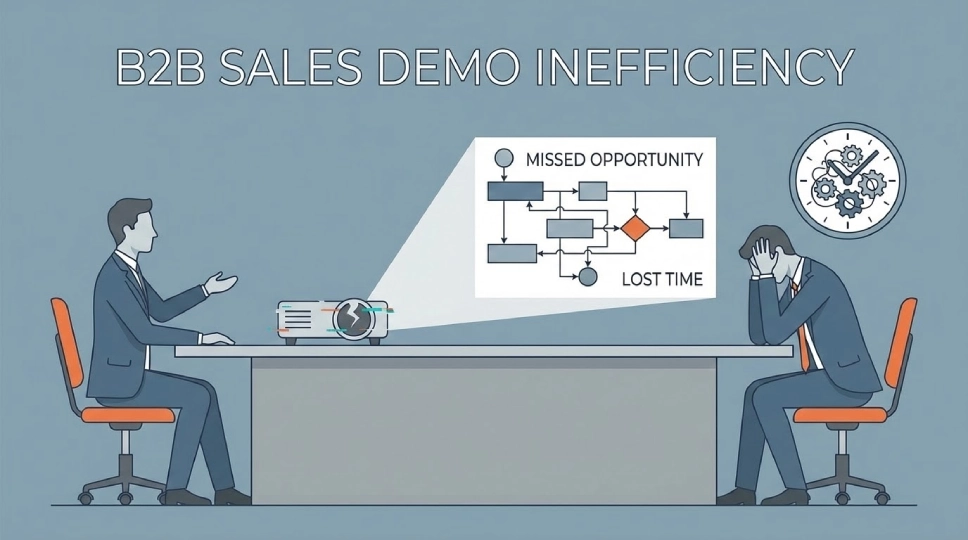
What Is Sales Demo Inefficiency in B2B?
Sales demo inefficiency in B2B is the wasted time sales reps spend on basic product education during demos instead of addressing specific buyer needs, handling objections, and advancing deals toward close.
Efficient demos assume prospects arrive with baseline understanding. They know what you do, who you serve, and basic differentiation. The demo time gets spent on specific use cases, technical details, and purchase decision factors.
Inefficient demos start from zero. Reps explain product categories, basic capabilities, and fundamental value props prospects should already understand. The discovery and value building that should fill demo time gets rushed or skipped.
Why Do Prospects Book Demos Without Basic Understanding?
Prospects book demos without basic understanding because your pre-demo education content is unclear, too long, or nonexistent, making the demo their first real attempt to grasp what you offer.
Three failures create this gap:
The Missing Foundation Content
Your website has feature lists and benefit claims but no clear “What is this actually?” explanation. Prospects read your homepage three times and still don’t understand your core function.
So they book demos to learn basics your content should have taught.
The Overwhelmed Prospect Problem
Your explainer is a 10-minute deep dive into every capability. Prospects watch 90 seconds, get overwhelmed, and stop. They arrive at demos having consumed partial, confusing information.
Incomplete understanding is worse than no understanding. Understanding how to explain complex products in 90 seconds prevents this problem.
The Gatekeeper Booking Dynamic
An operations manager books a demo for their VP. The VP didn’t request it, didn’t review your materials, and arrives asking “So what do you guys do again?”
Internal booking processes bypass your educational content entirely.
How Much Time Do Reps Actually Waste on Basic Explanation?
Top-performing sales reps waste 20-45% of demo time on basic product explanation that should occur before the meeting, with the percentage increasing as product complexity rises.
We analyzed 50 B2B SaaS demo recordings across 10 companies. Here’s what we found:
Simple SaaS Products (Single-Feature Tools)
20-25% of demo time spent on “What is this?” explanation. Example: A scheduling tool spends 12 minutes of a 60-minute demo explaining calendaring basics before showing advanced features.
Complex SaaS Products (Multi-Module Platforms)
35-45% of demo time spent on foundational education. Example: An analytics platform spends 25 minutes explaining data collection concepts before demonstrating actual insights.
Category-Creating Products (New Solutions)
40-50% of demo time spent on category education. Example: A new workflow automation tool spends 30 minutes explaining what workflow automation is before showing their specific approach.
The more complex or novel your product, the worse the inefficiency. This is why product demo videos that win deals front-load education before the live call.
What’s The Real Cost of Demo Inefficiency?
Demo inefficiency costs companies 30-50% of potential sales capacity, extends sales cycles by 20-40%, and reduces win rates by lowering the quality of value demonstrations.
Let’s calculate real impact:
The Capacity Cost
If your reps can conduct 4 quality demos per day, but 40% of each demo is wasted on basics, you’re effectively running at 60% capacity. That’s losing 1.6 demos worth of productivity daily per rep.
Five-person sales team × 1.6 lost demos × 20 working days = 160 lost monthly demo opportunities.
The Win Rate Impact
Rushed value demonstrations reduce win rates. When reps spend 40 minutes on basics and 20 minutes on value, they can’t adequately demonstrate fit, handle objections, or build conviction.
This typically reduces win rates from 25% to 18-20%. Same lead volume, significantly fewer closed deals.
The Sales Cycle Extension
Inadequate demos require follow-up calls to cover material that should have been addressed initially. This adds 1-2 weeks to average sales cycles.
If your sales cycle is 60 days, demo inefficiency stretches it to 75-80 days. That’s 20-25% longer time to revenue.
Why Don’t Sales Leaders See This Problem?
Sales leaders don’t see demo inefficiency because activity metrics look healthy, reps believe lengthy explanations are necessary, and the waste is distributed across hundreds of calls rather than concentrated in obvious failures.
The Activity Metric Illusion
Your dashboard shows strong demo volumes. Reps are hitting activity targets. The problem isn’t visible in “demos conducted” metrics because the demos are happening. They’re just inefficient.
You’re measuring quantity, not quality or efficiency.
The Rep Rationalization
Ask reps why demos take so long, they’ll say “Complex product requires thorough explanation.” They believe the time spent on basics is necessary, not wasteful.
Reps don’t recognize inefficiency as a problem when they think it’s part of the job.
The Distributed Waste Problem
If one rep wastes 100% of their time, that’s obvious. If 20 reps each waste 40%, it’s invisible. The waste is distributed across your entire team, making it hard to spot.
Aggregated inefficiency hides in plain sight.
What Should Happen Before a Demo Call?
Before demo calls, prospects should understand what your product does, who it serves, basic differentiation, and whether they’re a potential fit, allowing demo time to focus on specific buyer questions and purchase factors.
Pre-Demo Education Baseline
Prospects should arrive knowing:
- What problem category you solve
- Your basic approach or methodology
- Who typically uses your solution
- How you differ from primary alternatives
- Ballpark pricing or investment level
This baseline lets demos start at “How would this work for our specific situation?” instead of “What is this?”
The Self-Qualification Component
Good pre-demo content helps prospects self-qualify. They should recognize whether they’re a fit before booking. This reduces demos with completely wrong-fit prospects who consume capacity.
You want fewer, better-qualified demos. Not maximum demo volume.
How Does Video Fix Sales Demo Inefficiency?
Video fixes sales demo inefficiency by delivering consistent foundational education before demos, allowing sales time to focus on buyer-specific questions, objections, and decision factors rather than basic product education.
The Pre-Demo Education Video
Send a 90-second explainer video when prospects book demos. “Before our call, watch this quick overview so we can use our time together addressing your specific needs.”
This shifts basic education from synchronous (demo time) to asynchronous (prospect’s time). Learning how to create your first demo video establishes this foundation.
The Consistent Message Delivery
Your top rep explains things brilliantly. Your newest rep struggles with clarity. Video ensures every prospect gets the same high-quality baseline education regardless of who conducts the demo.
Consistency eliminates the rep skill variable in foundational education.
The Time Compression Advantage
Explaining something live takes 15-20 minutes. The same explanation in video takes 90 seconds because visual demonstration is more efficient than verbal description.
Video compresses education time by 90%.
What Types of Videos Eliminate Demo Waste?
Videos that eliminate demo waste include 60-90 second core explainers, 2-3 minute product overview tours, use case demonstrations, and differentiation summaries that prospects watch before live demos.
The 60-Second Core Explainer
What is this? Who is it for? What problem does it solve? This video answers the three questions consuming the first 20 minutes of your demos.
Send this when prospects book demos.
The 3-Minute Product Tour
Show your interface. Demonstrate basic workflows. Highlight key features visually. This eliminates the “show me what it looks like” time from live demos.
Prospects arrive having seen your product in action.
The Use Case Library
Create 90-second videos for your top 5 use cases. Send the relevant one based on prospect’s industry or role. This front-loads context-specific examples.
Demos can skip generic examples and go straight to prospect-specific applications. Understanding how explainer videos simplify complex products helps create these use case videos effectively.
The Differentiation Summary
A 2-minute video explaining how you differ from primary competitors. Prospects watch this before demos, arriving with competitive context.
This eliminates the “How are you different from [Competitor]?” detour that consumes demo time.
How Do You Restructure Demos Around Pre-Demo Education?
You restructure demos by assuming prospect knowledge from pre-demo videos, starting with discovery questions instead of product explanation, and focusing demo time on buyer-specific value demonstration.
The New Demo Structure
Old structure: Explain what you do (25 min) → Generic demo (20 min) → Q&A (15 min)
New structure: Discovery questions (15 min) → Customized demo addressing specific needs (35 min) → Decision advancement (10 min)
The time saved on explanation gets reinvested in higher-value activities.
The Assumption Shift
Start demos with “You watched our overview video, so you understand our basic approach. Let me ask about your specific situation…”
This signals that basic explanation time is over. We’re moving to advanced topics. Working with SaaS video production services that understand this demo preparation context ensures video content aligns with sales process needs.
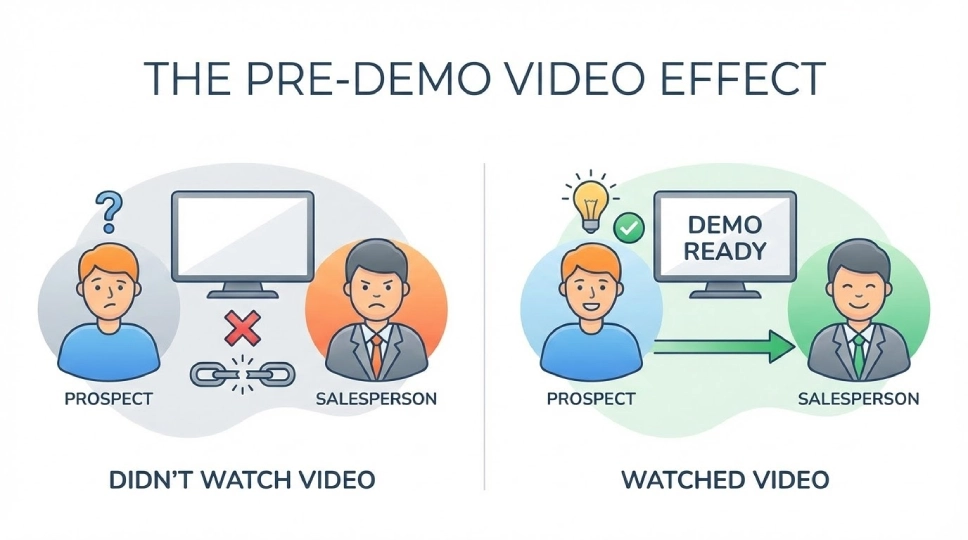
What Happens When Prospects Don’t Watch Pre-Demo Videos?
When prospects don’t watch pre-demo videos, you have three options: reschedule requiring video completion, conduct abbreviated education and shorter demo, or proceed with traditional inefficient demo structure.
The Reschedule Approach
“I see you haven’t watched our overview video yet. Let me reschedule for later this week so you have time to review it. That way we can focus our demo time on your specific needs rather than general explanations.”
This reinforces that your time is valuable and well-prepared prospects get better experiences.
The Compressed Education Approach
“Let me take 5 minutes to share our quick explainer video now, then we’ll have 25 minutes to discuss your specific situation.” Share screen, play the video, then proceed.
This salvages the demo but with reduced time for customization.
The Traditional Fallback
Proceed with traditional demo structure for prospects who won’t watch videos. But track conversion rates for video-watchers vs non-watchers.
Data will show video preparation improves outcomes, justifying firmer pre-demo requirements.
How Do You Measure Demo Efficiency Improvement?
You measure demo efficiency improvement by tracking time spent on foundational explanation versus buyer-specific discussion, demo-to-close conversion rates, and sales cycle length before and after implementing pre-demo education.
The Time Allocation Analysis
Record 10 demos before and after implementing pre-demo videos. Categorize time spent on: (1) Basic explanation, (2) Discovery, (3) Custom demonstration, (4) Objection handling, (5) Next steps.
Efficient demos spend 60%+ of time on categories 2-5. Inefficient demos spend 40%+ on category 1.
The Conversion Rate Comparison
Track demo-to-opportunity and demo-to-close conversion rates. Compare prospects who watched pre-demo videos versus those who didn’t.
Typically, video-prepared prospects convert 30-50% better because demos address their actual questions instead of basic education. This is part of understanding what sales impact to expect from videos at each funnel stage.
The Sales Cycle Impact
Measure average sales cycle length for deals with video-prepared demos versus traditional demos. Better demos that focus on decision factors typically reduce cycles by 15-25%.
What If Your Product Is Too Complex for Pre-Demo Video?
No B2B product is too complex for pre-demo video education, but complex products require modular video approaches addressing different aspects separately rather than comprehensive single-video explanations.
The Modular Video Approach
Create separate videos for: Core concept (90 sec) → How it works (3 min) → Key benefits (2 min) → Common use cases (90 sec each)
Prospects watch relevant modules based on their role and interests. They don’t need to consume everything.
The Tiered Education System
1st Level: 90-second overview everyone watches. 2nd Level: 3-minute deeper dive for serious prospects. 3rd Level: Technical details for evaluation stage.
Send appropriate level based on where prospects are in the buying journey. Understanding how to use explainer videos in every sales step helps structure this tiered approach.
The “Choose Your Path” Model
Send prospects three video options: “New to this category? Watch this.” “Evaluating multiple vendors? Watch this.” “Ready for technical details? Watch this.”
Prospects self-select based on their needs, getting relevant education without comprehensive overview.
How Do Top Sales Teams Enforce Pre-Demo Video Watching?
Top sales teams enforce pre-demo video watching through calendar automation that embeds videos in meeting confirmations, SDR qualification that confirms video viewing, and rescheduling policies for unprepared prospects.
The Calendar Automation
Demo booking confirmation emails automatically include: “Before our meeting, please watch this 90-second overview: [embedded video]. This allows us to focus our time on your specific needs.”
The video is impossible to miss because it’s in the booking confirmation.
The SDR Confirmation Check
When SDRs book demos, they confirm: “I’m sending you a quick overview video. Can you commit to watching it before the demo?” Get verbal confirmation.
This creates soft commitment increasing follow-through.
The Opening Question Strategy
Reps start demos with “What questions did our overview video raise for you?” This assumes they watched it and positions non-watchers as unprepared.
Social pressure encourages video completion for future demos.
What’s The Difference Between Demo Prep Videos and Demo Recording Videos?
Demo prep videos are short, foundational education sent before live demos to establish baseline understanding, while demo recording videos are full-length captures of actual demos sent to prospects who couldn’t attend or for later review.
Demo Prep Videos (Pre-Meeting)
Purpose: Educate prospects on basics before demos. Length: 60 seconds to 3 minutes. Content: What you do, who you serve, basic differentiation. When: Sent immediately when demo is booked.
Demo Recording Videos (Post-Meeting)
Purpose: Allow review or share with stakeholders who weren’t on call. Length: Full demo (30-60 min). Content: Custom demonstration addressing specific prospect needs. When: Sent after demos as follow-up.
You need both. Prep videos make live demos efficient. Recording videos extend demo impact to buying committee members who couldn’t attend. Learning how to write effective demo scripts helps create both types.
How Do You Get Executive Buy-In for Pre-Demo Video Investment?
You get executive buy-in by calculating current demo inefficiency costs, projecting capacity gains from video implementation, and running small pilots demonstrating conversion rate improvements before full rollout.
The Cost Calculation
Calculate: Number of monthly demos × Average demo length × Percentage spent on basics × Average rep fully-loaded cost per hour.
Example: 200 demos/month × 60 min × 40% waste × $100/hour = $8,000 monthly in wasted sales capacity. That’s $96,000 annually.
Video investment of $15,000 pays back in under 2 months. This mirrors the mistake of launching without explainer videos but applied to sales efficiency.
The Capacity Projection
If video reclaims 40% of demo time, your 5-person sales team gains the equivalent of 2 additional reps’ worth of demo capacity. No hiring required.
That’s real productivity improvement with measurable revenue impact.
The Pilot Proof
Run a 30-day pilot with 2-3 reps using pre-demo videos. Track their conversion rates versus control group. Typical results show 30-40% improvement in demo-to-opportunity conversion.
Proof of concept makes full rollout approval easy.
What Content Should Never Go Into Pre-Demo Videos?
Pre-demo videos should never include detailed pricing, technical architecture specifics, competitor criticisms, or custom implementations because these topics require discussion context and buyer-specific customization.
Avoid Pricing Details
Pricing needs context. Different prospects have different needs requiring different packages. Video can mention price ranges or investment levels, but detailed pricing belongs in conversations.
Skip Technical Architecture
Technical buyers need deep technical details, but most prospects don’t. Save architecture discussions for technical evaluation calls with relevant stakeholders.
Pre-demo videos serve broad audiences. Technical content alienates non-technical decision makers.
No Competitor Bashing
Differentiation is valuable. Direct competitor criticism backfires in video. It seems defensive and unprofessional without conversational context.
Show your strengths. Let prospects draw competitive conclusions.
How Does Video Education Impact Different Sales Roles?
Video education impacts SDRs by improving qualification accuracy, AEs by increasing demo productivity, and SEs by reducing redundant technical explanations, creating efficiency gains across the entire sales org.
The SDR Impact
SDRs share videos during prospecting. Prospects who watch videos and still want demos are better qualified. This improves SDR-to-AE handoff quality and reduces wasted AE time on poor-fit demos.
The AE Impact
AEs reclaim 40% of demo time for high-value activities like discovery, objection handling, and closing conversations. This directly improves win rates and shortens sales cycles.
The SE Impact
Sales Engineers spend less time on basic technical education and more time on architecture design and integration planning. This elevates their role from educators to consultants.
What Are The Signs Your Demos Need Video Support?
Your demos need video support when prospects frequently ask “What is this?” during demos, when demo recordings show extensive basic explanation time, or when conversion rates are low despite high demo volumes.
The Question Pattern Signal
Review demo recordings for questions like “Wait, so what does this actually do?” “Is this for marketing or sales?” “How is this different from [basic category]?”
These questions signal prospects lack foundational understanding. This is why every SaaS product needs an explainer video integrated into the sales process.
The Recording Review Evidence
If you can’t watch your own demo recordings without fast-forwarding through the first 20 minutes, your prospects are suffering through the same basic content every time.
Redundant content should live in video, not live demos.
The Conversion Rate Disconnect
High demo volumes but low conversion rates suggest demos aren’t effectively demonstrating value. Often this is because too much time goes to basics instead of value building.
How Do You Train Reps to Use Pre-Demo Videos Effectively?
You train reps to use pre-demo videos effectively through demo structure workshops, role-play scenarios assuming prospect knowledge, and conversion data showing video-prepared prospects close faster.
The Structure Workshop
Run workshops deconstructing current demos. Show time allocation analysis. Demonstrate new demo structure that assumes video education occurred.
Reps need to see the inefficiency before they’ll change behavior.
The Role-Play Practice
Practice demos where “prospects” have watched videos and arrive with baseline knowledge. This forces reps to skip basics and start with discovery.
Uncomfortable at first, but it reveals how much more productive demos become.
The Data Demonstration
Share conversion data showing video-prepared prospects convert 30-50% better. Reps adopt new behaviors when they see clear performance advantages.
Show them that video prep isn’t extra work, it’s competitive advantage. Understanding where to place videos for maximum demo impact helps reps leverage videos throughout the sales cycle.
Why Traditional Demo Training Doesn’t Fix This Problem
Traditional demo training doesn’t fix inefficiency because it focuses on demo delivery skills rather than prospect preparation, treating symptoms instead of addressing the root cause of prospects arriving unprepared.
Demo training teaches reps to explain better, handle objections smoother, and demonstrate features clearer. These are valuable skills. But they don’t address the fundamental problem: prospects shouldn’t need basic explanation during demos.
Better explanation is still wasteful explanation. Video eliminates the need for explanation entirely by front-loading education.
You can train a rep to explain your product in 15 minutes instead of 25. Or you can create a 90-second video that does it better and reclaim all 25 minutes for selling.
What Results Can You Expect From Fixing Demo Inefficiency?
Fixing demo inefficiency typically increases effective sales capacity by 30-40%, improves demo-to-opportunity conversion by 25-35%, and reduces sales cycles by 15-20% while improving rep satisfaction and reducing burnout.
Real companies see real results:
A Series B SaaS company implemented pre-demo education videos. Within 90 days, their reps were conducting 30% more productive demos monthly with the same team. Win rates improved from 22% to 31%. Average sales cycle dropped from 67 days to 54 days.
The video investment was $12,000. The capacity gain was equivalent to hiring 1.5 additional reps without the $300,000 annual cost.
That’s not incremental improvement. That’s structural transformation of sales productivity. Working with experienced explainer video production services that understand sales enablement ensures videos integrate effectively into demo workflows.
Your best reps are spending half their demo time on education that should happen before the meeting. Prospects arrive unprepared because you haven’t given them effective pre-demo content. The waste is invisible because it’s distributed across every demo.
Within 60 days, you can create pre-demo education videos, implement them in your demo booking flow, and start measuring efficiency improvements. Your reps gain 40% more productive demo time, conversion rates improve because demos address buyer needs instead of basic education, and your sales capacity expands without adding headcount.
The companies dominating their categories in 2026 stopped accepting demo inefficiency as normal. They built video-supported sales processes that let reps focus on selling instead of educating. Working with USA-based video production teams who understand B2B sales processes helps you join them.
Ready to reclaim 40% of your demo time? Let’s build the pre-demo videos that make every demo more productive.