
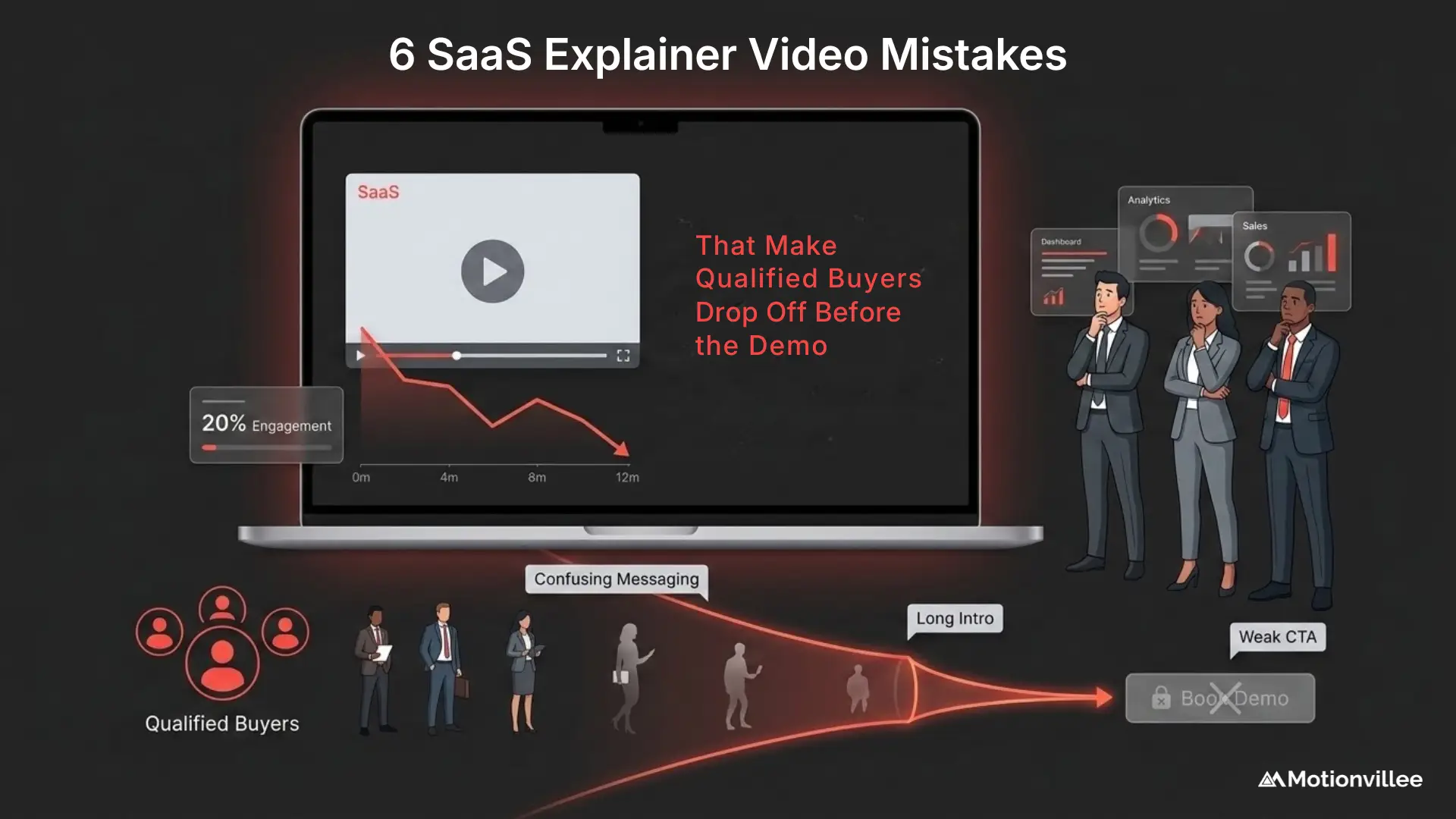
6 SaaS Explainer Video Mistakes That Make Qualified Buyers Drop Off Before the Demo
Most SaaS explainer videos fail long before the product gets judged.
That’s the uncomfortable truth.
Teams spend weeks polishing animations, refining transitions, selecting background music, and improving voiceovers—while ignoring the one thing that actually matters:
Does the video move the buyer closer to the demo?
Because that’s the real purpose of a SaaS explainer video.
Not views.
Not aesthetics.
Not “brand storytelling.”
The goal is progression.
And when qualified buyers drop off before booking a demo, the issue is usually not the product.
It’s communication.
Most buyers don’t leave because they hate your solution. They leave because they don’t understand why it matters to them quickly enough.
Let’s break down the biggest explainer video mistakes SaaS companies keep making and why they quietly destroy conversions before sales even gets a chance to speak to the prospect.
Mistake 1: Trying to Explain Everything at Once
This is by far the most common mistake.
The video tries to:
- Explain the industry
- Educate the audience
- Show every feature
- Differentiate from competitors
- Build emotional connection
- Pitch the product
- Drive conversion
All within 60-90 seconds.
The result?
Mental overload.
When viewers receive too much information too quickly, they stop processing. And once clarity disappears, attention disappears with it.
A good explainer video has one clear objective.
That’s it.
If the goal is awareness, focus on the problem.
If the goal is conversion, focus on product clarity.
If the goal is onboarding, focus on usability.
But trying to do all three at once usually weakens all three.
This is why structured messaging frameworks like Process of creating animated explainer video matter so much. Simplicity is not about reducing value—it’s about improving understanding.
The simpler the communication feels, the easier it becomes for buyers to move forward confidently.
Mistake 2: Starting With the Product Instead of the Problem
A surprising number of SaaS explainer videos open with:
- Dashboards
- Features
- UI walkthroughs
- Technical capabilities
But buyers don’t emotionally connect with features first.
They connect with pain points.
If the first few seconds fail to establish relevance, the viewer disconnects mentally before the actual message even begins.
The best explainer videos start with:
- Frustration
- Inefficiency
- Workflow bottlenecks
- Missed opportunities
Because once the buyer feels understood, they become more willing to listen.
For example, instead of saying:
“Our AI platform automates workflow management…”
A stronger opening would be:
“Your team spends more time managing approvals than actually executing campaigns.”
That immediately creates context.
This aligns closely with concepts from How an Animated Explainer Video Can Boost Your Business, where emotional clarity increases viewer engagement and retention.
People pay attention to solutions only after they recognize the problem.
Mistake 3: Making the Video Too Generic
Most SaaS explainer videos sound interchangeable.
“Streamline operations.”
“Scale faster.”
“Improve efficiency.”
“Transform collaboration.”
The problem is that these phrases are vague and overused.
Qualified buyers are comparing multiple products at the same time. If your messaging sounds identical to everyone else, your product becomes forgettable instantly.
Specificity builds credibility.
Instead of:
“Improve communication across teams”
Say:
“Reduce approval delays between marketing and compliance teams by centralizing feedback.”
That feels tangible.
Specific messaging helps buyers visualize real use cases instead of abstract promises.
And real converts better than polished generic language every single time.
Mistake 4: Overusing Animation Without Clarity
Animation is supposed to support communication.
But many SaaS videos treat animation like decoration.
Too many transitions.
Too much movement.
Too many visual effects.
The result is visual fatigue.
The viewer spends more energy processing motion than understanding the message.
Good animation simplifies complexity.
Bad animation distracts from it.
This is where many teams misunderstand the purpose of visual storytelling.
The visuals are not the message.
They support the message.
That’s why some of the highest-performing SaaS videos are actually visually simple. They prioritize clarity, pacing, and communication over visual overload.
This principle is often discussed in How to boost conversions with animated explainer video, where clarity directly impacts user decision-making.
Because buyers don’t convert because animations look impressive.
They convert because the message feels clear and relevant.
Mistake 5: Ignoring Funnel Stage Intent
Not every viewer wants the same information.
Someone discovering your brand for the first time does not need:
- Advanced integrations
- Technical architecture
- Deep workflow explanations
But many SaaS videos immediately jump into product complexity.
That creates friction.
Top-of-funnel viewers need:
- Simplicity
- Relevance
- Problem awareness
Middle-of-funnel viewers need:
- Product understanding
- Feature clarity
- Use-case examples
Bottom-of-funnel viewers need:
- Proof
- Product demos
- Customer validation
When the message doesn’t match the viewer’s intent, drop-offs increase naturally.
This is why video alignment matters so much.
And it’s also why frameworks like There’s a video for every business type, find yours are useful. Different funnel stages require different communication styles.
Trying to use one video everywhere usually weakens performance everywhere.
Mistake 6: Ending Without Direction
This mistake quietly destroys conversion momentum.
The video ends beautifully…
And then does nothing.
No next step.
No clear CTA.
No transition into the buyer journey.
The viewer finishes watching and thinks:
“Okay… now what?”
An explainer video should guide progression naturally.
Depending on the funnel stage, the CTA could be:
- Book a demo
- Start a free trial
- Watch a deeper walkthrough
- Download a guide
- Contact sales
Without direction, even interested buyers lose momentum.
And in SaaS, momentum matters.
Because buyers rarely make decisions immediately. They need guided progression through the funnel.
A weak ending creates hesitation.
And hesitation kills conversion.
Why Qualified Buyers Actually Drop Off
Most drop-offs are not caused by weak production quality.
They happen because:
- The messaging feels unclear
- The positioning sounds generic
- The video overloads information
- The pacing feels confusing
- The content doesn’t match buyer intent
That’s what creates friction.
And friction is one of the biggest conversion killers in SaaS marketing.
Especially today, where buyers already deal with endless information every single day.
If your video makes them work harder to understand the value, they leave.
What High-Performing SaaS Explainer Videos Do Differently
The best-performing SaaS videos usually follow a very simple structure:
- Identify the problem quickly
- Establish relevance emotionally
- Introduce the solution clearly
- Show practical value
- Reduce uncertainty
- Guide the next step
That’s it.
No unnecessary complexity.
No trying to impress everyone.
Just clarity and progression.
And when combined with strategies like How to promote your animated explainer video?, the impact becomes much stronger because the right message reaches the right audience at the right time.
The Bigger Problem Most Teams Ignore
Here’s what many SaaS companies misunderstand:
An explainer video is not just a creative asset.
It’s part of the sales process.
Which means it should be measured using:
- Demo conversions
- Viewer retention
- Funnel progression
- Sales enablement impact
Not vanity metrics like views alone.
Because a visually beautiful video that doesn’t move buyers forward is still underperforming.
Final Thought
Qualified buyers rarely drop off because they “don’t like videos.”
They drop off because the video creates confusion instead of clarity.
And in SaaS, clarity drives momentum.
The best explainer videos are not necessarily the most cinematic or visually impressive.
They are the ones that make the buyer think:
“This solves my problem. I need to learn more.”
That’s the real goal.
Everything else is secondary.