
How to Use Google Flow AI for B2B Video Marketing: 8 Features Every Marketing Team Should Know
B2B video marketing is going through a shift that’s easy to underestimate. It’s not just about making better videos anymore. It’s about making them faster, testing them quicker, and adapting based on what actually works.
For a long time, production was the bottleneck. Ideas had to wait. Campaigns moved slowly. Iteration was expensive.
Now AI is changing that layer.
Tools emerging from the ecosystem of Google often powered by research from Google DeepMind are pushing toward a workflow where content is generated, refined, and scaled with far less friction.
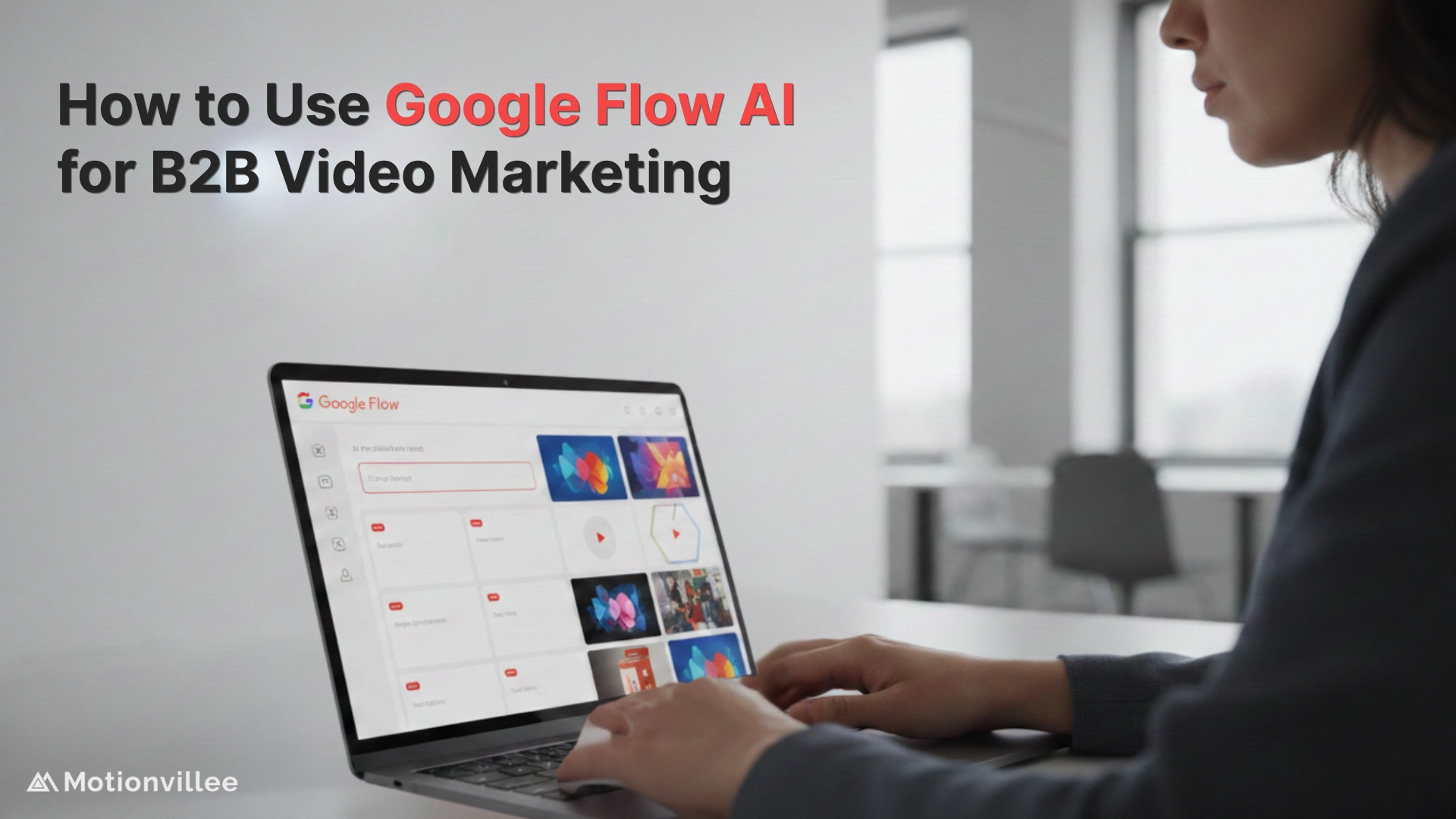
Google Flow AI sits in that shift. It’s not just a tool, it’s part of a broader move toward AI assisted video creation that blends generation, editing, and distribution into one system.
Let’s break down how B2B teams can actually use it and where it fits without overhyping it.
What is Google Flow AI?
Google Flow AI refers to AI-driven video creation and optimization capabilities that integrate across platforms like YouTube and Google Ads.
Instead of working in isolated tools, the idea is to:
- Generate video from text or prompts
- Automate editing and structure
- Optimize content based on performance data
- Distribute and test within the same ecosystem
Think of it as reducing the distance between idea and performance.
Earlier, you had to create content first and measure later. Now the system is designed to inform creation based on performance signals from the start.
Why It Matters for B2B Marketing
B2B marketing has always been slower than B2C. Longer sales cycles, more stakeholders, more layers of approval.
That makes speed even more valuable.
AI tools like Google Flow AI create leverage in three ways:
- Faster turnaround on content creation
- Ability to test multiple narratives before committing
- Reduced dependency on large production pipelines
But none of this works without strong fundamentals. The principles discussed in How an Animated Explainer Video Can Boost Your Business still apply. AI just helps you execute those principles more efficiently.
The shift is not from strategy to automation. It’s from slow execution to fast execution.
1. AI-Powered Script-to-Video Generation
At the core is the ability to turn scripts into visual output.
You input a structured idea or prompt, and the system generates scenes that align with your narrative.
This is particularly useful in B2B contexts where clarity matters more than visual complexity:
- SaaS product explainers
- Workflow demonstrations
- Concept-based storytelling
It directly compresses steps outlined in Process of Creating Animated Explainer Video, removing manual scene-building and early-stage design work.
Instead of spending days visualizing a concept, you can get a rough version instantly and refine from there.
2. Smart Scene Generation and Narrative Flow
One of the underrated capabilities is how AI handles transitions and structure.
Instead of manually deciding how each scene connects, the system predicts logical flow based on context.
This reduces the need for micro-level editing decisions and helps maintain narrative continuity.
For B2B teams, this matters because most videos are not cinematic they are explanatory. Flow matters more than visual complexity.
And when the structure is handled well, the message lands better.
3. AI-Based Voiceovers and Multilingual Narration
Voiceovers often delay production. Recording, editing, retakes it all adds up.
AI removes that friction.
You can generate voiceovers in multiple tones, accents, and languages instantly. This opens up:
- Faster campaign launches
- Easier localization for global markets
- A/B testing of tone and messaging
This aligns well with strategies from How to build your brand with animated explainer videos, where consistency in tone builds brand perception over time.
Now that consistency can be scaled across regions without increasing effort.
4. Automated Video Personalization
Personalization is one of the biggest opportunities in B2B marketing, especially in account-based strategies.
Google Flow AI can dynamically adjust:
- Messaging for different industries
- Visual elements for different personas
- Calls to action based on funnel stage
This turns one base video into multiple targeted versions.
Instead of creating separate content for every segment, you adapt intelligently.
That’s a major shift in efficiency.
5. Deep Integration with Distribution Platforms
Because this sits within Google’s ecosystem, it connects directly to platforms like Google Ads and YouTube.
This shortens the loop between creation and performance.
You can:
- Launch video campaigns faster
- Test variations in real time
- Optimize based on live data
In traditional workflows, feedback loops take time. Here, they are almost immediate.
For performance driven B2B marketing, that’s a serious advantage.
6. AI-Assisted Editing and Format Optimization
Editing is where most teams lose time.
AI helps by:
- Suggesting cuts based on engagement
- Optimizing pacing
- Adjusting format for different platforms
This becomes especially useful when adapting content for different channels, as explained in Why Vertical Videos Rule Facebook and Instagram?.
Instead of re-editing everything manually, the system adapts formats intelligently.
That’s where scale becomes realistic.
7. Data-Driven Content Recommendations
One of the more powerful aspects is how AI feeds insights back into creation.
Instead of guessing what works, the system can:
- Highlight high-performing formats
- Suggest improvements
- Identify drop-off points
This connects directly with distribution thinking like How to promote your animated explainer video?, where performance insights guide reach and engagement.
The difference is that now those insights influence content creation itself, not just distribution.
8. Scalable Content Repurposing
Most B2B teams underuse their content.
A single video can be broken into multiple assets, but that usually requires manual effort.
Google Flow AI simplifies this by:
- Converting long videos into short clips
- Reframing content for different platforms
- Reusing visuals across campaigns
Instead of constantly creating new content, you extend what you already have.
Where Google Flow AI Still Falls Short
It’s not a perfect system.
There are still gaps:
- Limited control over highly specific brand design
- Risk of repetitive or generic outputs
- Less effective for emotionally driven storytelling
For deeper creative work, structured frameworks like Best tools for creating animated explainer videos still matter.
AI accelerates execution, but it doesn’t replace creative direction.
The Smart Way to Use It
The best approach is hybrid.
Use Google Flow AI for:
- Rapid content creation
- Testing multiple ideas
- Scaling output across channels
Then refine strong concepts through strategic production.
This keeps you fast without sacrificing quality.
Final Thought
Google Flow AI represents a shift, not just a feature upgrade.
It changes how quickly ideas turn into content, how easily content turns into campaigns, and how fast campaigns turn into insights.
For B2B marketers, that speed compounds.
Because when execution becomes easier, the real advantage shifts to clarity of thinking.
The teams that win won’t just use AI tools.
They’ll use them to learn faster, test smarter, and stay ahead of the curve while everyone else is still planning.
But the real edge still comes from strategy.
Because when everyone has access to AI tools, the difference is not who can create content.
It’s who knows what content to create, and when to use it.
That’s where the real leverage is.