
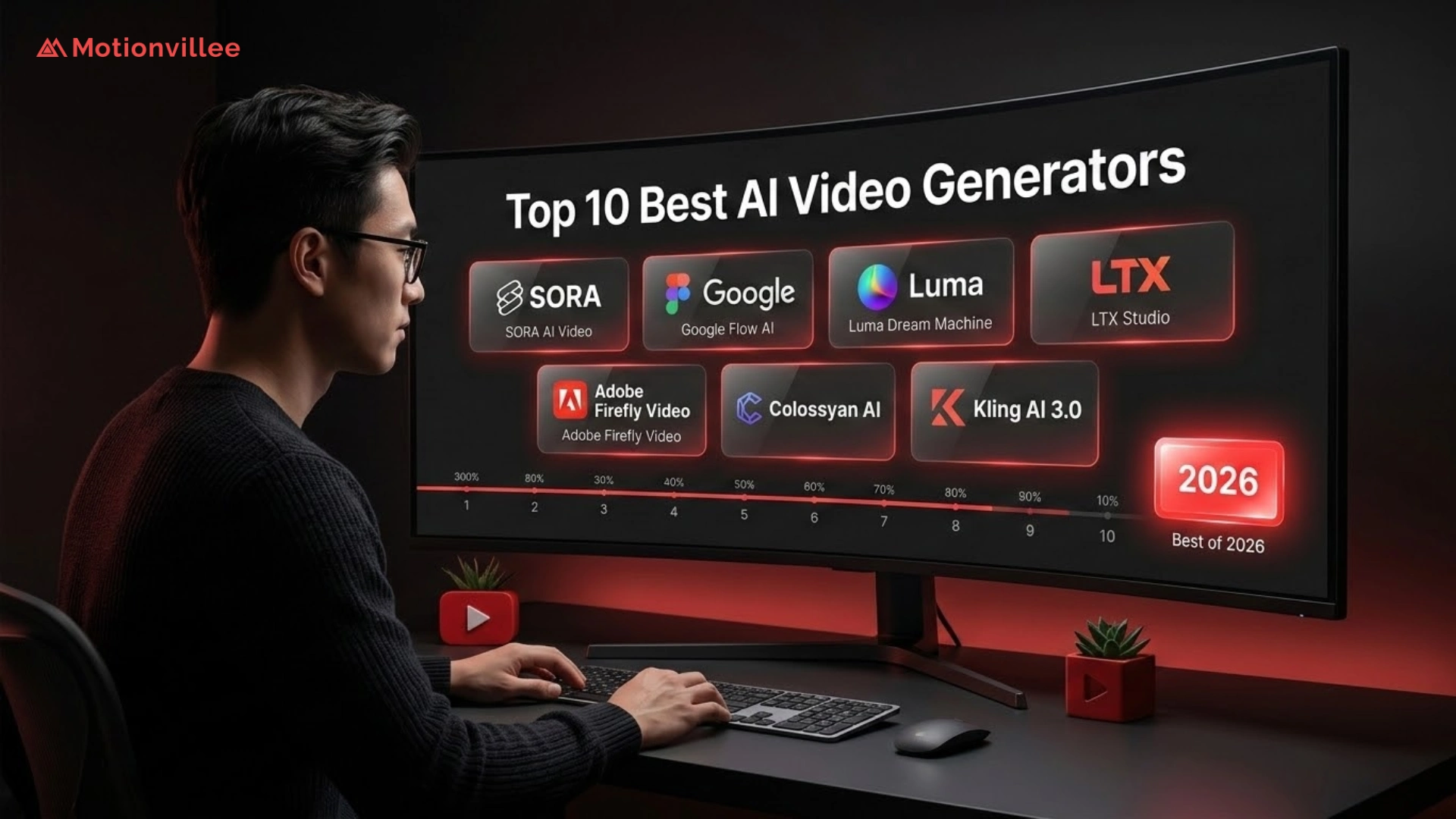
Top 10 Best AI Video Generators in 2026
AI video generation has shifted from experimentation to real business use.
A year ago, many teams used AI tools for quick experiments and social media content. In 2026, B2B brands are using AI platforms to create explainers, product videos, campaign assets, training content, short form clips, and even cinematic storytelling.
The biggest change is not the technology itself.
It’s the workflow.
Marketing teams are now asking:
- Can this tool reduce production time
- Can it scale content creation
- Can it improve creative output
- Can it work safely for brands
- Can it create content without large production costs
The answer increasingly depends on choosing the right platform.
Different AI tools solve different problems.
Some specialize in text to video generation.
Some focus on avatars.
Others help with storytelling, ideation, or editing workflows.
This guide breaks down ten of the strongest AI video platforms in 2026 and where each one fits.
1. Sora AI
Sora became one of the most discussed AI video tools because of its ability to create realistic videos directly from text prompts.
Instead of assembling templates, users describe scenes and generate entirely new video outputs.
Strong use cases:
- Brand storytelling
- Campaign visualization
- Creative concept development
- Product scenarios
- Advertising experiments
Sora works particularly well for teams exploring AI-generated visual storytelling.
This aligns closely with AI powered text to video workflows
Current limitation:
Creative control still matters. Human refinement remains important.
2. Google Flow AI
Google Flow focuses heavily on AI assisted visual creation and workflow efficiency.
Rather than acting as a single purpose generator, it supports collaborative content creation and ideation.
Useful for:
- Creative planning
- Video concept generation
- Team workflows
- Campaign experimentation
Teams exploring AI-enabled creative systems may benefit from video workflow automation methods
3. Kling AI 3.0
Kling AI gained attention because of its highly realistic outputs.
Its photorealistic capabilities made it particularly useful for product-focused content.
Popular use cases include:
- Product demonstrations
- Marketing visuals
- Realistic motion generation
- Brand campaigns
Many teams evaluating realism focused platforms explore photorealistic content approaches
4. Luma Dream Machine
Luma Dream Machine focuses heavily on rapid idea generation.
Rather than replacing complete production pipelines, it helps accelerate brainstorming and creative exploration.
Best for:
- Concept visualization
- Story ideation
- Mood testing
- Creative experiments
This mirrors AI brainstorming workflows
For marketing teams, speed of ideation can often matter as much as production itself.
5. LTX Studio
LTX Studio takes a broader storytelling approach.
Instead of simply generating clips, it helps users create structured narratives.
Features include:
- Storyboarding
- Scene generation
- Script planning
- Character consistency
This follows AI storytelling systems
For teams creating larger campaigns, storytelling workflows become increasingly valuable.
6. Adobe Firefly Video AI
Adobe approached AI differently.
Commercial safety became a major focus.
Many B2B brands worry about:
- Licensing concerns
- Copyright risk
- Commercial usage restrictions
Adobe positioned Firefly around safer enterprise workflows.
This reflects commercial AI content frameworks For larger companies, safe usage policies matter almost as much as visual quality.
7. Colossyan AI
Colossyan focuses on AI avatars and team communication.
Rather than cinematic generation, it specializes in:
- Training content
- Internal communication
- Educational videos
- Team collaboration
This aligns with AI avatar video systems
For B2B companies creating scalable communication content, avatar tools create significant efficiency gains.
8. Renderforest
Renderforest remains a practical option for marketers needing speed and templates.
Instead of advanced AI scene generation, it focuses on:
- Video intros
- Social content
- Business explainers
- Marketing videos
This supports template-based content creation
Not every business needs cinematic AI outputs.
Sometimes speed wins.
9. Opus Clip
Creating content is difficult.
Repurposing content consistently is often harder.
Opus Clip focuses on:
- Video clipping
- Social snippets
- Caption generation
- Repurposing workflows
This connects with content repurposing systems
For teams producing webinars and podcasts regularly, repurposing becomes critical.
10. Traditional Explainer + AI Hybrid Workflows
Not every winning workflow relies entirely on AI.
Many brands increasingly combine AI with structured explainer strategies.
This includes:
- AI assisted scripts
- Motion graphics
- Human editing
- Storytelling frameworks
This follows modern explainer approaches
Because AI creates efficiency.
Strategy creates results.
How to Choose the Right AI Video Tool
Different tools solve different problems.
If you need:
Storytelling: Sora, LTX Studio
Photorealism: Kling AI
Commercial safety: Adobe Firefly
Avatar videos: Colossyan
Repurposing: Opus Clip
Templates: Renderforest
Brainstorming: Luma Dream Machine
Workflow collaboration: Google Flow
Choosing the best tool depends less on popularity and more on use case.
Final Thought
There is no universal “best” AI video generator.
The strongest tool depends entirely on what your team actually needs.
Some companies need faster editing.
Some need scalable explainers.
Some need photorealistic generation.
Others simply need more content from existing assets.
The most effective B2B teams in 2026 are not chasing every AI platform.
They are building smarter workflows around the right ones.
And that difference matters much more than the tools themselves.